Not thelast word.
1 An assistant can prepare the page.
It cannot take responsibility for it.
Drafting, summarisation and document tools that leave room for the most important part of writing: your judgement. Read about the work ↗

For teams who write to think, explain and decide.
Not merely to fill a page.
More considered writing.
Less mechanical work.
Last Word Technology develops neural language tools for organisations whose work depends on documents. We help with drafting assistants, summarisation, editorial style checks and document automation, shaped around your sources and your review process.
The point is not to make every paragraph sound machine-made. It is to reduce avoidable effort without disguising uncertainty or moving responsibility away from the people who know the subject. A tool should make a draft easier to inspect, not merely faster to produce.
We start with a defined writing task, a named owner and a realistic account of the material available. If a template, a clearer source or a simpler rule is the better answer, that belongs in the discussion too.
A first draft.
Not a final position.
A useful drafting assistant begins with the shape of the document. What is it for? Who will read it? Which facts must come from an approved source, and where is interpretation still needed? We define those boundaries before considering how the language should sound.
The work can include document outlines, structured drafting instructions, approved examples and review prompts. A reviewer should be able to distinguish supplied facts from proposed wording and see where information is missing.
We do not offer automatic publication or an unreviewed substitute for professional judgement. Your people check the facts, the implications and the final text. The assistant prepares something to work with; it does not settle your organisation’s position.
Shorter does not
always mean clearer.
A summary can lose the qualification that matters most. We design summarisation tasks around purpose: an orientation for a colleague, a decision brief or a structured digest of an agreed document set.
We discuss what must survive compression, which source references a reader needs and when a summary should say the material is incomplete. Outputs are tested for unsupported statements as well as omissions. They do not replace reading the original where the stakes require it.
Your organisation provides authorised material and defines the audience. We help make the trade-offs explicit rather than treating a fluent short paragraph as proof that the source has been faithfully represented.
On the art of keeping enough ↗A suggestion,
not a verdict.
Choose a lens for the same illustrative sentence. This is a fixed demonstration of editorial priorities, not a live language model or a check of your document. Selections are not saved.
OriginalIt is anticipated that the implementation may potentially facilitate improvements in the document preparation process.
The tool may help people prepare documents more easily.
The shorter version removes inflated wording but keeps uncertainty. A reviewer still needs evidence for the underlying claim.
Join the documents.
Keep the decisions.
Repeated document work often involves more than generating paragraphs. Information must be collected, fields checked, sections assembled and a version put in front of the right reviewer. We help design that route using structured templates and agreed sources.
The automation should not blur the point at which a person approves a document. We discuss missing information, incompatible inputs, version naming and how rejected drafts return for revision. If a document cannot be completed safely, the workflow needs a visible stop.
Available interfaces, tool permissions and data-handling arrangements shape what is feasible. We do not imply universal compatibility or supply a ready-made document platform. Each engagement is scoped around your existing process and the handoff it needs to improve. Explore document workflows ↗
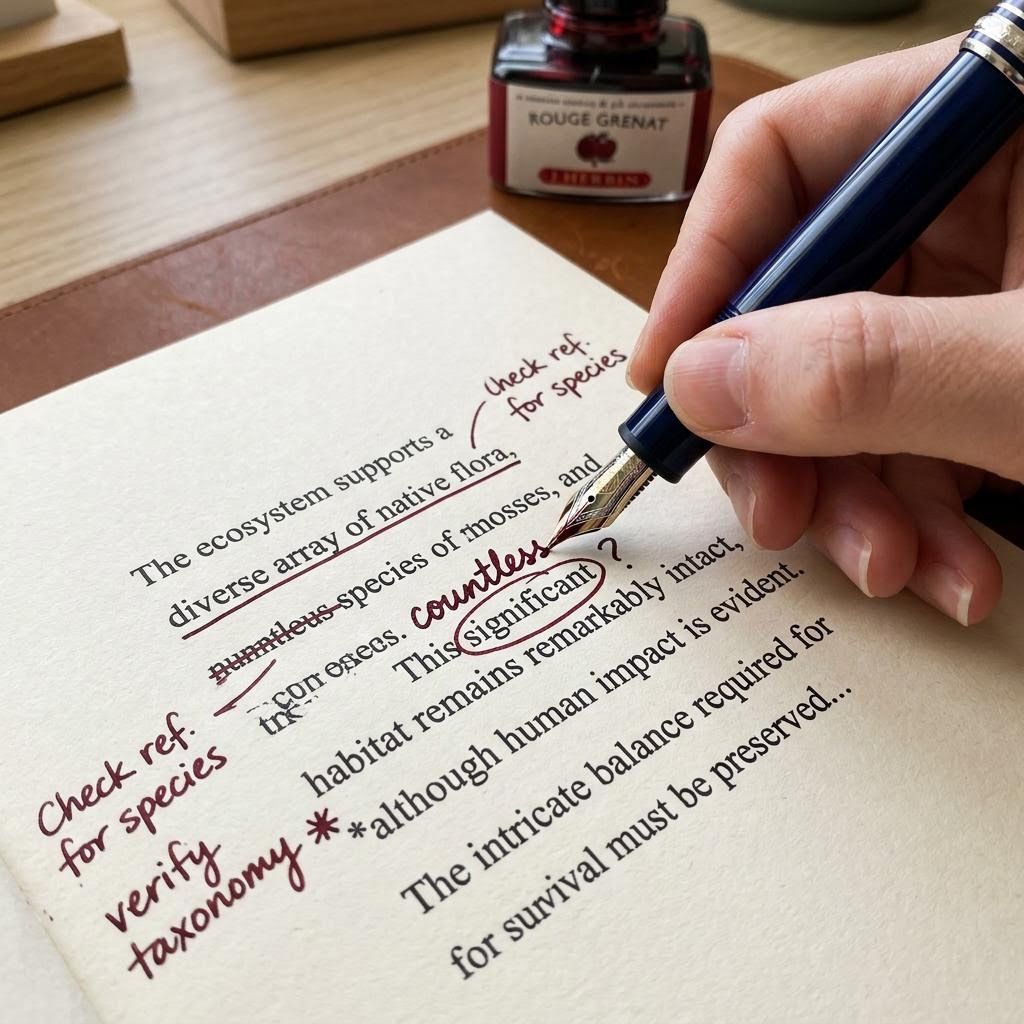
Read the room.
Read the source.
Revise the tool.
We begin with the writing task and the people who do it. We agree a bounded first use, inspect representative material and define what a good result would need to preserve. Project access is arranged separately; private documents do not belong in an initial enquiry.
A first configuration is tried against ordinary examples and difficult ones. Reviewers look for invented claims, omissions, distorted emphasis and awkward handoffs. The findings guide revisions and determine whether it is sensible to extend the scope.
Handover records the agreed sources, instructions, review responsibilities and limitations. Ongoing care is a separate conversation, not an implied promise that a model will behave identically after every tool or source change.
Read the working method ↗Who has
the last word?
Use this local checklist to consider a proposed writing workflow. Your answers are not stored or submitted, and the result is not a compliance assessment.
Begin with an accountable reviewer. A polished draft does not approve itself.
Good prose is not
the same as good evidence.
A polished output can still be wrong. We evaluate a language workflow against the task it is supposed to support, not against a general impression of eloquence. Are the claims supported? Has a crucial condition disappeared? Can the reviewer trace the information that matters?
We agree representative examples, expected behaviour and a way to record problems before making claims about usefulness. Where a tool performs poorly, the response may be to narrow the task, improve the source or stop using that approach.
No uplift figures, invented client results or universal accuracy guarantees are offered here. We look for inspectable improvements to the work and honest limits on what the system can do. The final editorial and business decision stays with your organisation.
Worth a word.
Will a tool replace our writers or editors?
That is not the premise of our service. We design assistance around a defined task and meaningful human review. Your organisation decides responsibilities, approves documents and retains editorial judgement.
Can we use our own style and source material?
Yes, where the material is authorised and suitable for the agreed tools. We review permissions, data handling and the state of the source before project access is arranged. Do not send private documents through this website.
What about legal, clinical or other specialist documents?
We provide software and workflow assistance, not regulated advice or professional sign-off. Qualified reviewers remain responsible for specialist content and for deciding whether AI assistance is appropriate at all.
What needs
writing next?
Tell us what your organisation writes, where the work becomes repetitive and what your reviewers must be able to trust. An outline is enough to begin. Leave private documents, sensitive records and passwords out of the first exchange.
Write to Last WordMonday–Friday, 09:00–18:00 Europe/London, with daylight saving.
For an existing workflow, send a support request.